
Overview
In enterprise event-driven architectures, synchronizing core CRM transactions with external microservices, Kafka event streams, and cloud data warehouses requires reliable, sub-second messaging.
Historically, Salesforce developers connected to the Event Bus using the Streaming API (CometD / EMP Connector over Long-Polling HTTP/1.1 with Bayeux protocol). While functional, CometD struggled under heavy enterprise volumes: JSON payloads introduced massive serialization overhead, connections suffered from proxy timeouts, and publishing required separate REST or SOAP API round-trips.
The Salesforce Pub/Sub API (api.pubsub.salesforce.com) is the modern, high-performance standard for event streaming. Built on gRPC over HTTP/2 with Apache Avro binary serialization, it provides up to 10x higher message throughput, bidirectional streaming flow control, and a unified endpoint for publishing and subscribing.
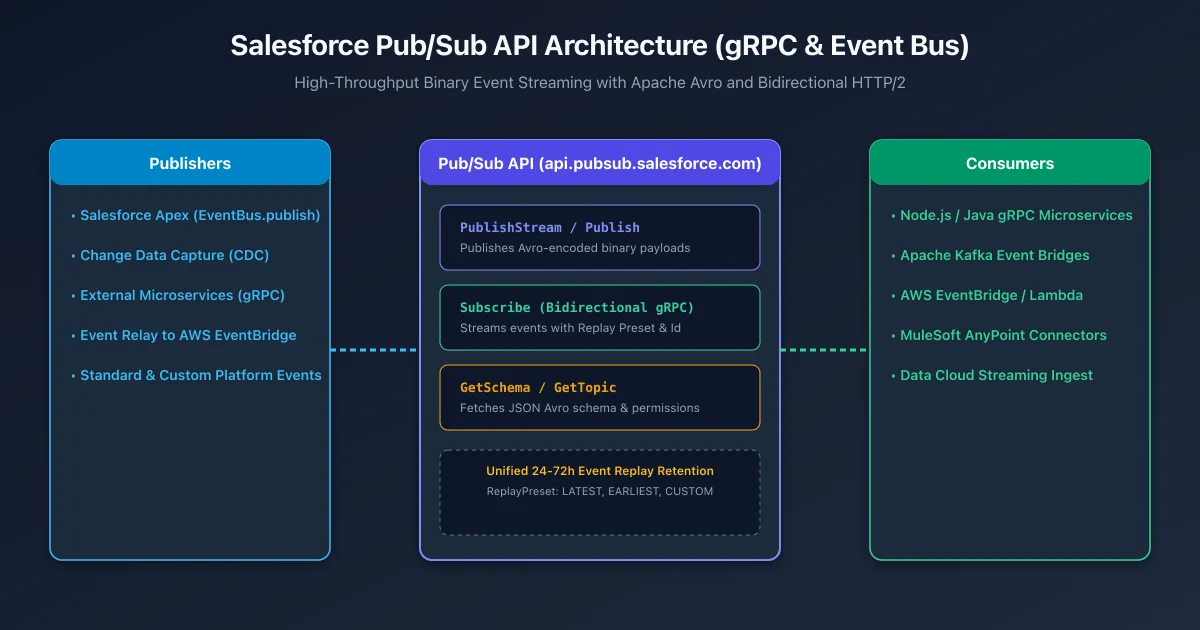
Technical Comparison: Pub/Sub API vs Legacy CometD
| Feature | Legacy CometD Streaming API | Modern Pub/Sub API (gRPC) |
|---|---|---|
| Transport Protocol | HTTP/1.1 (Long-Polling / WebSockets) | HTTP/2 (Multiplexed Streams) |
| Serialization | Text-based JSON (High byte overhead) | Apache Avro (Compact Binary) |
| Communication Pattern | Unidirectional subscription (Publish via REST) | Bidirectional gRPC (Unified Pub & Sub) |
| Flow Control | Best-effort push (Risk of client buffer overflow) | Client-driven credit-based fetch_size |
| Schema Grounding | Implicit runtime JSON | Strongly typed Schema ID via GetSchema |
| Event Replay Retention | 24 to 72 hours | Unified 72 hours across high-volume buses |
Core gRPC Service Definition & RPC Methods
The Pub/Sub API proto file defines four primary Remote Procedure Calls (RPCs):
service PubSub {
  // Subscribe to an event topic with client-driven flow control
  rpc Subscribe (stream FetchRequest) returns (stream FetchResponse);

  // Publish a batch of events synchronously
  rpc Publish (PublishRequest) returns (PublishResponse);

  // High-throughput bidirectional publish stream
  rpc PublishStream (stream StreamPublishRequest) returns (stream StreamPublishResponse);

  // Retrieve Avro JSON schema string by Schema ID
  rpc GetSchema (SchemaRequest) returns (SchemaInfo);

  // Retrieve topic metadata and publish/subscribe capabilities
  rpc GetTopic (TopicRequest) returns (TopicInfo);
}
1. Subscribe (Bidirectional Flow-Controlled Streaming)
Clients establish a persistent bidirectional stream. The client initiates the stream by sending a FetchRequest specifying the topic_name, replay_preset, and num_requested (batch size). The server streams back ConsumerEvent messages until num_requested is fulfilled, pausing until the client sends another request for more messages.
2. Publish & PublishStream
Allows external systems to publish single or bulk events directly into the Salesforce Event Bus without passing through standard REST DML limits.
3. GetSchema & Dynamic Serialization
Every event published to the Event Bus contains a schema_id. Clients query GetSchema once to cache the Apache Avro JSON schema definition and deserialize the binary payload into structured application objects.
Replay Presets & Fault-Tolerant Consumption
If a downstream consumer crashes or loses network connectivity, the Salesforce Event Bus guarantees message persistence for 72 hours. The Pub/Sub API exposes three replay presets:
| ReplayPreset | Behavior | Recommended Use Case |
|---|---|---|
LATEST |
Delivers only new events published after subscription starts. | Real-time dashboards, ephemeral UI push notifications. |
EARLIEST |
Replays all available events retained within the 72-hour window. | Rebuilding a damaged read replica, fresh subscriber bootstrap. |
CUSTOM |
Resumes playback immediately after the specified binary replay_id. |
Production microservices (persisting last processed checkpoint). |
Example: Consuming Events with Node.js & gRPC
Below is a complete, production-grade Node.js subscriber implementation using @grpc/grpc-js and avsc (Avro parser):
import grpc from '@grpc/grpc-js';
import protoLoader from '@grpc/proto-loader';
import avro from 'avsc';

const PROTO_PATH = './pubsub_api.proto';
const packageDefinition = protoLoader.loadSync(PROTO_PATH, {
  keepCase: true,
  longs: String,
  enums: String,
  defaults: true,
  oneofs: true
});
const pubsubProto = grpc.loadPackageDefinition(packageDefinition).eventbus.v1;

// Initialize gRPC Client with Salesforce OAuth Bearer Token
const client = new pubsubProto.PubSub(
  'api.pubsub.salesforce.com:7443',
  grpc.credentials.combineChannelCredentials(
    grpc.credentials.createSsl(),
    grpc.credentials.createFromMetadataGenerator((_, callback) => {
      const meta = new grpc.Metadata();
      meta.add('accesstoken', process.env.SF_ACCESS_TOKEN);
      meta.add('instanceurl', process.env.SF_INSTANCE_URL);
      meta.add('tenantid', process.env.SF_TENANT_ID);
      callback(null, meta);
    })
  )
);

const schemaCache = new Map();

async function getSchema(schemaId) {
  if (schemaCache.has(schemaId)) return schemaCache.get(schemaId);
  return new Promise((resolve, reject) => {
    client.GetSchema({ schema_id: schemaId }, (err, response) => {
      if (err) return reject(err);
      const parsedType = avro.Type.forSchema(JSON.parse(response.schema_json));
      schemaCache.set(schemaId, parsedType);
      resolve(parsedType);
    });
  });
}

// Start Bidirectional Subscribe Stream
const call = client.Subscribe();

call.on('data', async (fetchResponse) => {
  for (const consumerEvent of fetchResponse.events) {
    const avroType = await getSchema(consumerEvent.event.schema_id);
    const decodedPayload = avroType.decode(consumerEvent.event.payload);

    console.log('Received Event:', {
      replayId: consumerEvent.replay_id.toString('hex'),
      payload: decodedPayload
    });
  }

  // Request next batch of 25 events (Flow Control)
  call.write({ num_requested: 25 });
});

call.on('error', (err) => console.error('gRPC Stream Error:', err));

// Initial Request: Subscribe from LATEST with batch size 25
call.write({
  topic_name: '/event/Order_Fulfillment__e',
  replay_preset: 1, // 1 = LATEST
  num_requested: 25
});
Event Relay: Zero-Code Streaming to AWS EventBridge
For organizations hosted on Amazon Web Services (AWS), writing custom microservices to poll Salesforce events is unnecessary. Event Relay integrates the Salesforce Event Bus natively with Amazon EventBridge.
- Create an AWS Named Credential in Salesforce Setup containing the target AWS Account ID and IAM role.
- Define an
EventRelayConfigmetadata component linking your Platform Event (e.g.,Order_Fulfillment__e) to the AWS EventBridge partner event source. - Salesforce automatically streams events over secure AWS PrivateLink channels directly into AWS Lambda, SQS, or Step Functions without custom middleware.
Frequently asked questions
What is the primary advantage of the Pub/Sub API over legacy CometD Streaming API?
The Pub/Sub API uses gRPC over HTTP/2 with binary Apache Avro serialization, delivering up to 10 times higher throughput, bidirectional flow control, and unified publish and subscribe endpoints compared to CometD Long-Polling.
How long are platform events retained for replay in the Salesforce Event Bus?
Standard platform events are retained for 72 hours in high-volume event buses. Consumers can use ReplayPreset values EARLIEST, LATEST, or pass a custom 24-byte binary Replay ID to recover missed events during network outages.
What are the core RPC methods exposed by api.pubsub.salesforce.com?
The service exposes four core RPC methods: Subscribe for bidirectional event streaming with client flow control, Publish and PublishStream for publishing events, GetSchema for retrieving JSON Avro schemas, and GetTopic for topic metadata.
How does flow control work in the Pub/Sub API Subscribe stream?
The client specifies fetch_size in its SubscribeRequest. The server streams exactly that number of events and waits until the client sends a subsequent request requesting more events, preventing buffer overflow on slow consumer microservices.
How does Event Relay connect Salesforce Platform Events to Amazon Web Services?
Event Relay automatically forwards Platform Events and Change Data Capture events directly from the Salesforce Event Bus to Amazon EventBridge using an AWS Named Credential, eliminating custom polling middleware.
Comments
Questions, corrections and tips are welcome. Comments are GitHub Discussions, so you sign in with GitHub.