
Overview
The official Salesforce Developer Documentation portal (developer.salesforce.com/docs) serves as the authoritative source of truth for platform architects, software engineers, and integration developers. With hundreds of distinct developer guides, API specifications, and reference manuals spanning more than twenty years of platform evolution, navigating the documentation library requires understanding its architectural taxonomy.
The documentation is organized around six foundational architectural pillars: Core Platform & Languages, APIs & Integration Services, Metadata & Application Lifecycle Management (ALM), Agentforce & Einstein AI, Data Cloud & Lakehouse, and Revenue & Industry Clouds.
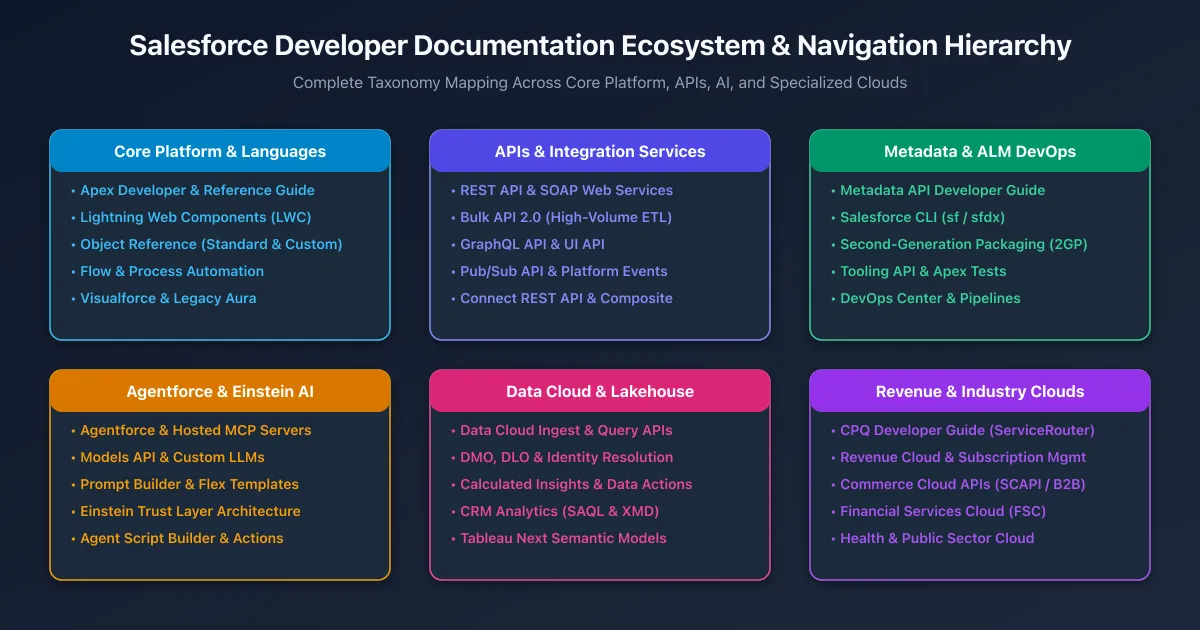
Pillar 1: Core Platform & Programming Languages
This section houses the guides for building custom business logic, user interfaces, and automated workflows directly on the Lightning Platform.
1. Apex Developer Guide & Reference
- URL:
https://developer.salesforce.com/docs/atlas.en-us.apexcode.meta/apexcode/apex_intro.htm - What It Covers:
- Apex language syntax, object-oriented concepts, and execution flow.
- Governor limits (SOQL, DML, Heap, CPU timeouts) and transaction management.
- Triggers, context variables, and trigger frameworks.
- Asynchronous Apex: Queueable, Batchable, Schedulable, and Future methods.
- System namespace reference (
System,Database,Schema,ConnectApi).
2. Lightning Web Components (LWC) Developer Guide
- URL:
https://developer.salesforce.com/docs/component-library - What It Covers:
- Modern web standards-based reactive UI framework.
- Component lifecycle hooks (
connectedCallback,renderedCallback,disconnectedCallback). - Lightning Data Service (LDS) wire adapters and functions (
getRecord,updateRecord). - Base components library (
lightning-input,lightning-datatable,lightning-card). - Inter-component communication via Custom Events and Lightning Message Service (LMS).
3. Object Reference for the Salesforce Platform
- URL:
https://developer.salesforce.com/docs/atlas.en-us.object_reference.meta/object_reference/sforce_api_objects_intro.htm - What It Covers:
- Complete data dictionary for standard objects (
Account,Contact,Opportunity,Case,Task). - Field types, system audit fields, picklist defaults, and relationships (Lookup vs Master-Detail).
- Big Objects, Platform Event definitions, and Change Data Capture entities.
- Complete data dictionary for standard objects (
Pillar 2: APIs & Integration Services
The Salesforce API Library (developer.salesforce.com/docs/apis) outlines the programmatic endpoints used by external applications, middleware, and microservices to exchange data with Salesforce.
| API Name | Documentation Link | Protocol / Format | Recommended Workload |
|---|---|---|---|
| REST API | REST API Guide | HTTP / JSON / XML | Synchronous record CRUD, search, and lightweight transactions. |
| Bulk API 2.0 | Bulk API 2.0 Guide | Async REST / CSV | Batch importing or querying datasets >2,000 records up to 150M records/day. |
| GraphQL API | GraphQL API Guide | GraphQL / JSON | Eliminating over-fetching in mobile and single-page apps with a single round-trip query. |
| Pub/Sub API | Pub/Sub API Guide | gRPC / HTTP/2 / Binary | Real-time event streaming for Platform Events and Change Data Capture (CDC). |
| Connect REST API | Connect REST Guide | HTTP / JSON | Simplified, business-process-oriented access to Chatter, CMS, and B2B Commerce. |
| SOAP API | SOAP API Guide | SOAP / WSDL / XML | Strongly typed enterprise integrations requiring strict enterprise or partner contracts. |
Pillar 3: Metadata, DevOps & Developer Tools
Salesforce’s modern developer tooling focuses on source-driven development, scratch org lifecycles, and automated continuous delivery.
1. Metadata API Developer Guide
- URL:
https://developer.salesforce.com/docs/atlas.en-us.api_meta.meta/api_meta/meta_intro.htm - What It Covers:
- XML representations of all customizable elements (
CustomObject,ApexClass,Flow,PermissionSet). - Package manifest (
package.xml) structure and wildcards. - Synchronous and asynchronous metadata retrieval and deployment pipelines.
- XML representations of all customizable elements (
2. Salesforce CLI Command Reference (sf)
- URL:
https://developer.salesforce.com/docs/atlas.en-us.sfdx_cli_reference.meta/sfdx_cli_reference/cli_reference.htm - What It Covers:
- Modern
sfcommands for org authorization, source push/pull, and scratch org creation. - Deploying metadata using
sf project deploy start. - Executing Apex unit tests via
sf apex run test.
- Modern
3. Second-Generation Packaging (2GP) Guide
- URL:
https://developer.salesforce.com/docs/atlas.en-us.sfdx_dev.meta/sfdx_dev/sfdx_dev_dev2gp.htm - What It Covers:
- Unlocked packages for enterprise modular application architecture.
- Managed 2GP packages for Independent Software Vendors (ISVs).
- Versioning, dependency resolution, and automated CI/CD packaging pipelines.
Pillar 4: Agentforce & Einstein AI
The newest and fastest-growing segment of the developer documentation covers generative AI, autonomous agent design, and enterprise AI orchestration.
- Agentforce Developer Guide:
https://developer.salesforce.com/docs/einstein/genai/guide- Configuring autonomous agents, topics, instructions, and standard/custom actions.
- Hosted Model Context Protocol (MCP) server integration (
platform/sobject-*,platform/headless-360, and custom servers).
- Models API Developer Guide:
https://developer.salesforce.com/docs/einstein/genai/guide/models-api.html- Calling foundation LLMs directly from Apex (
aiplatform.ModelsAPI) or REST. - Integrating custom third-party models via Bring Your Own Model (BYOM).
- Calling foundation LLMs directly from Apex (
- Prompt Builder & Flex Templates:
https://developer.salesforce.com/docs/einstein/genai/guide/prompt-templates.html- Authoring dynamic prompts grounded with CRM record data, Apex classes, and Flow resources.
- Einstein Trust Layer Architecture:
- Zero-retention agreements, automated data masking, toxicity detection, and audit logging.
Pillar 5: Data Cloud & Lakehouse Analytics
Documentation for zero-copy data federation, real-time streaming, and high-speed analytical querying.
- Data Cloud Developer Guide:
https://developer.salesforce.com/docs/atlas.en-us.c360a_api.meta/c360a_api/c360a_api_intro.htm- Data ingestion APIs (Web SDK, Mobile SDK, Ingestion API).
- Data Lake Objects (DLOs) to Data Model Objects (DMOs) mapping.
- Identity Resolution rules and unified profile generation.
- Data Cloud Query SQL API:
- Executing ANSI-compliant SQL queries against lakehouse tables via REST and MCP (
post_dc_query_sql).
- Executing ANSI-compliant SQL queries against lakehouse tables via REST and MCP (
- CRM Analytics & SAQL Reference:
https://developer.salesforce.com/docs/atlas.en-us.bi_dev_guide_saql.meta/bi_dev_guide_saql/bi_saql_intro.htm- Salesforce Analytics Query Language (SAQL) syntax, window functions, and Extended Metadata (XMD).
Pillar 6: Revenue & Industry Cloud Guides
Salesforce provides specialized developer manuals for enterprise industries and business applications:
- Salesforce CPQ Developer Guide:
https://developer.salesforce.com/docs/revenue/cpq-developer-guide/guide/cpq-developer-intro.html- The
SBQQ.ServiceRouterprogrammatic quoting gateway (read,load,save). - Custom Calculator Plugins (QCP) and bundle configuration models.
- The
- Salesforce Commerce Cloud (SCAPI):
https://developer.salesforce.com/docs/commerce/commerce-api- Headless Shopper and Admin REST APIs, Composable Storefront PWA Kit, and Webhook integrations.
- Financial Services Cloud (FSC) Developer Guide:
- Financial Accounts, Household data models, and regulatory compliance APIs.
- OmniStudio & Business Process Engine:
- OmniScripts, Integration Procedures, DataRaptors, and Calculation Matrices.
How to Choose the Right Salesforce Developer Resource
| If your task is… | Start with this official guide | Primary Technology |
|---|---|---|
| Writing custom triggers or transactional business logic | Apex Developer Guide | Apex, SOQL, Unit Tests |
| Building interactive UI components in record pages | Lightning Web Components Reference | HTML5, Modern ES6+, CSS |
| Connecting an external system for high-volume ETL | Bulk API 2.0 Developer Guide | REST, CSV, Async Jobs |
| Building event-driven architectures with real-time push | Pub/Sub API Developer Guide | gRPC, Protocol Buffers, CDC |
| Deploying code and managing CI/CD release pipelines | Salesforce CLI Reference & 2GP Guide | CLI (sf), GitHub Actions |
| Implementing AI agents and autonomous assistants | Agentforce & Models API Guides | Generative AI, MCP, Prompts |
| Querying unified cross-cloud customer data lakes | Data Cloud Query SQL API Guide | ANSI SQL, Lakehouse, DMOs |
| Headless quoting and automated contract amendments | Salesforce CPQ Developer Guide | SBQQ.ServiceRouter, Apex |
Frequently asked questions
What are the primary entry points for official Salesforce developer documentation?
The primary portal is developer.salesforce.com/docs, which organizes resources into the Salesforce API Library, Apex and LWC developer guides, Object Reference, Metadata API, and cloud-specific developer centers.
What is the difference between the Salesforce Object Reference and the Metadata API Guide?
The Object Reference documents standard database tables and their fields for runtime data access via SOQL, SOSL, and REST. The Metadata API Guide documents XML types used to configure and deploy application schemas and code.
Where can developers find API documentation for Agentforce and AI models?
Agentforce guides and AI documentation are located under the Agentforce and Einstein hubs, detailing the Models API, Prompt Builder templates, Agent Script Builder, and Hosted Model Context Protocol servers.
How do Salesforce release cycles affect developer documentation versions?
Salesforce updates developer guides three times a year corresponding to Spring, Summer, and Winter releases. URLs often include release versions or redirect to the current active release version such as API v68.0.
Which API guide should be used for integrating large datasets into Salesforce?
The Bulk API 2.0 Developer Guide is the recommended resource for loading or querying datasets containing more than 2,000 records asynchronously, providing higher throughput than standard REST or SOAP APIs.
Where is the documentation for Salesforce CLI and modern DevOps workflows?
Salesforce CLI documentation, scratch org setup, and Second-Generation Packaging guides are hosted under the Developer Tools and DevOps Center sections on the official documentation portal.
Comments
Questions, corrections and tips are welcome. Comments are GitHub Discussions, so you sign in with GitHub.